
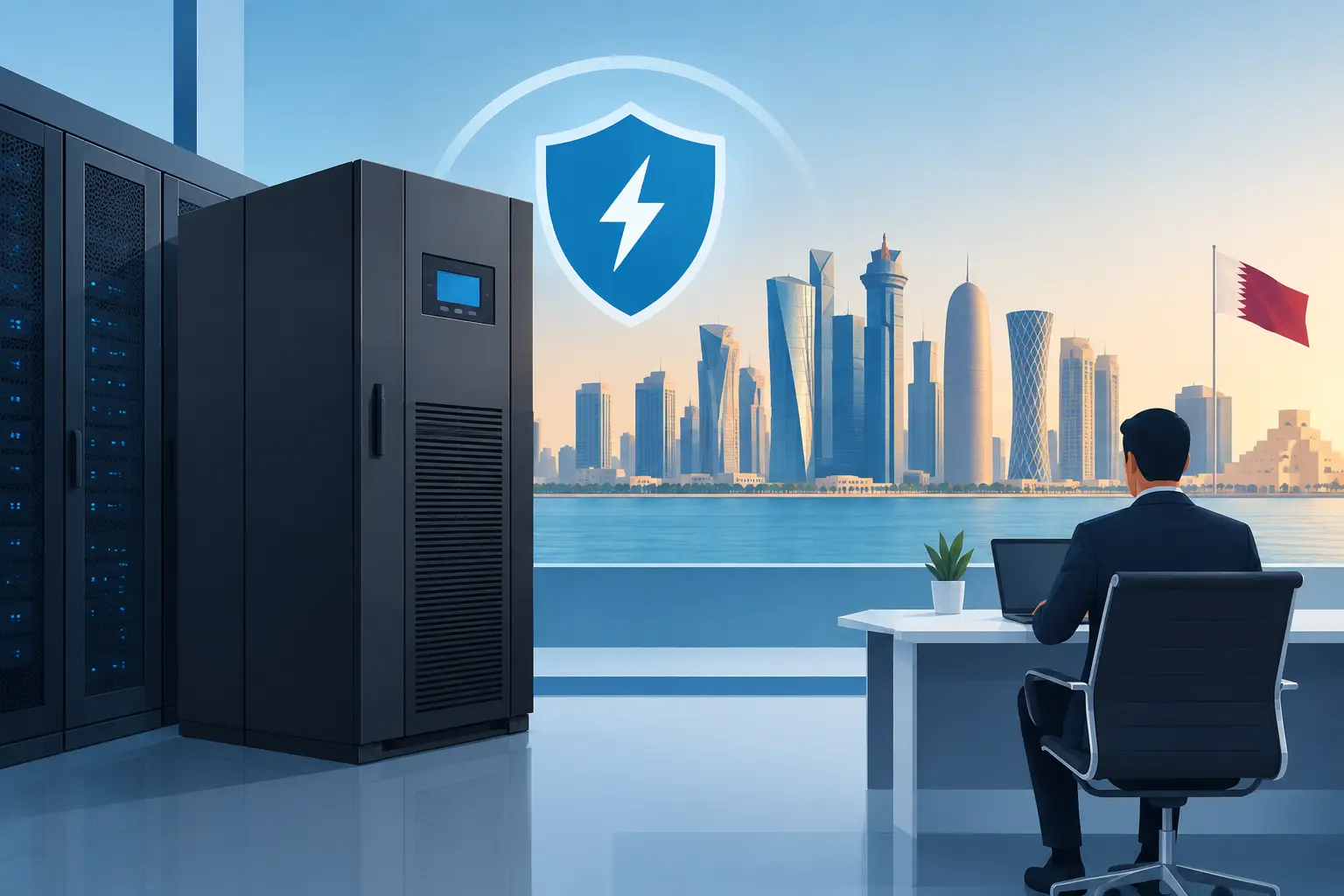

A brief voltage fluctuation can be enough to restart a server, interrupt a critical transaction, corrupt data or take a network offline. For organisations that cannot afford those consequences, an Eaton UPS Qatar solution is not simply a backup battery. It is a planned layer of business continuity for the equipment that keeps daily operations moving.
From a small office network cabinet to a multi-rack server room, the right UPS protects against outages, surges, sags and unstable utility power. The right design also gives IT teams the time to shut systems down safely, keep essential services operating, and investigate the cause of a power event without creating a wider operational issue.
Why power protection deserves a business decision
Many organisations only review UPS capacity after an unexpected shutdown. By then, the immediate cost can include lost staff time, unavailable applications, damaged equipment, failed transactions and a difficult recovery process. In sectors such as healthcare, hospitality, retail, education, logistics and government, even a short interruption can affect services well beyond the IT team.
A UPS provides conditioned power between the mains supply and connected equipment. When the input supply becomes unstable or fails, the UPS switches to battery power or continuously supplies conditioned output, depending on its topology. This protects connected loads while giving generators time to start, or allowing an orderly shutdown where extended runtime is not required.
The requirement is not identical for every site. A receptionist’s desktop and a core virtualisation host should not be specified in the same way. Criticality, load profile, future expansion, required runtime and the quality of the existing electrical environment all need to shape the selection.
Choosing an Eaton UPS in Qatar for the right environment
Eaton offers UPS systems across desktop, network, server room and data centre requirements. The practical question is not which model has the largest rating. It is which system provides suitable protection, runtime and manageability for the equipment your organisation relies on.
Office and branch protection
For workstations, point-of-sale equipment, routers, switches and small network cabinets, line-interactive UPS units can be a cost-effective option. They help manage common voltage variations and provide short-term battery support during a power loss. This is often appropriate where the goal is to maintain connectivity, protect productive work, or allow a controlled shutdown.
However, battery runtime should be assessed honestly. A small UPS may keep a router online for a useful period, but it may not support a full office floor, multiple printers and every connected device. Identifying essential loads prevents overspending on non-critical equipment while protecting the systems that matter most.
Server rooms and business-critical systems
Server rooms generally require a higher level of protection. Online double-conversion UPS systems continually regenerate output power, isolating sensitive servers, storage, network infrastructure and security systems from irregularities in the incoming supply. This architecture is particularly valuable for environments hosting business applications, databases, communications platforms and shared files.
Eaton 9PX and 9SX solutions are commonly considered for rack and tower deployments where power quality, efficiency and monitoring are priorities. The suitable configuration depends on the load, rack space, redundancy approach and anticipated battery runtime. For example, a server room may need enough runtime to bridge generator start-up, whereas a site without generator backup may require longer battery autonomy for a safe shutdown.
Data centres and larger facilities
Larger data centres, campuses and facilities with high-density IT loads may require three-phase UPS capacity, scalable architecture and parallel redundancy. Eaton systems in this category support more complex power protection strategies, including N+1 resilience where continuity requirements justify the additional investment.
This is where design discipline matters most. A UPS that is too small will limit growth and may operate under excessive load. One that is significantly oversized can increase capital cost and reduce efficiency at low utilisation. A professional load assessment balances present demand with realistic expansion plans rather than relying on guesswork.
The sizing details that protect your investment
UPS sizing should start with the actual equipment load in watts, not only the VA figure shown on a device label. Modern servers, storage arrays and switches can have varying consumption based on workload, installed components and power supply configuration. Measuring active loads or reviewing manufacturer specifications provides a more dependable starting point.
It is also wise to allow capacity for growth. A business adding a new Dell PowerEdge server, expanding storage or increasing network ports in six months should not need to replace a recently installed UPS. A sensible headroom allowance supports future-ready infrastructure, but it should be proportionate to credible plans.
Battery runtime is the second major decision. Five to ten minutes may be enough where a generator starts automatically and has been regularly tested. Longer runtime may be necessary for remote branches, sites with no generator, or systems that need time to close applications and complete backups. External battery modules can extend runtime in selected configurations, although they require additional space, budget and maintenance planning.
Finally, consider power distribution and physical installation. Rack-mounted UPS units must fit the available cabinet depth and weight limits. Tower systems need secure, ventilated floor space. Input and output connections, bypass arrangements and electrical circuit capacity should be checked before delivery, especially for higher-capacity installations.
Monitoring turns a UPS into an operational tool
A UPS should not be treated as equipment that sits unnoticed until an outage occurs. Network monitoring allows authorised teams to review load levels, battery condition, input events and alarms. It can also trigger notifications when batteries approach end of life or a unit is nearing capacity.
For virtualised environments and critical servers, compatible power management software can coordinate graceful shutdowns. This reduces the risk of file corruption and helps preserve service integrity when an outage extends beyond the available battery runtime. The value is not just in keeping equipment powered for a few more minutes. It is in giving the organisation control over what happens next.
Battery health deserves particular attention in Qatar’s climate. UPS batteries perform best in a controlled environment. High ambient temperatures can shorten battery life, while poor ventilation and neglected inspection schedules increase the chance of an avoidable failure. Regular checks of temperature, alarms, battery condition and load levels should form part of an IT maintenance programme.
Genuine equipment, local accountability
For a business-critical UPS, product origin and after-sales support are as important as the technical specification. Genuine Eaton products with official manufacturer warranty help protect your investment and provide confidence in performance, compatibility and service coverage.
Delta Business Systems W.L.L. supplies Eaton power protection for organisations across Qatar, with local stock availability in Doha for selected requirements, fast delivery and competitive corporate or bulk pricing on request. The team can assess the protected load, recommend an appropriate Eaton UPS configuration, arrange installation and configuration, and support the wider environment through IT AMC and 24/7 technical support services.
This local approach is particularly useful when a project includes servers, storage, racks, networking and power protection. Rather than treating the UPS as an isolated purchase, organisations can align it with their wider infrastructure plan, generator strategy, backup requirements and expected growth.
When replacement is the better option
An older UPS can appear functional until the moment it is tested by a real outage. Frequent alarms, reduced runtime, overheating, repeated battery replacement or insufficient capacity are signs that a review is overdue. Batteries can often be replaced economically, but this is not always the right answer. If the UPS itself is ageing, lacks network monitoring or cannot support new equipment, replacement may offer better long-term value.
A planned replacement also avoids the pressure of sourcing power protection during an emergency. It gives the business time to confirm requirements, schedule installation outside working hours and test the new solution properly. That is a far safer route than discovering a limitation during a power event.
For an Eaton UPS quotation, load assessment or product consultation, email business@dbsqatar.com or call +974 3139 3916. The best power protection strategy is the one that keeps your essential systems available while giving your team a clear, tested response when utility power does not cooperate.


Permalink