
A brief voltage dip may pass unnoticed on office lighting, yet it can restart a server, interrupt a storage write or take a network switch offline at the wrong moment. For organisations assessing online UPS versus line interactive protection, the real decision is not simply about UPS price. It is about how much electrical disturbance critical systems can tolerate and what the cost of interruption looks like.
A UPS provides battery-backed power during an outage, but its design determines how it handles everyday voltage variation, electrical noise and the changeover to battery power. Selecting the right architecture protects more than equipment. It supports staff productivity, data integrity, customer service and business continuity.
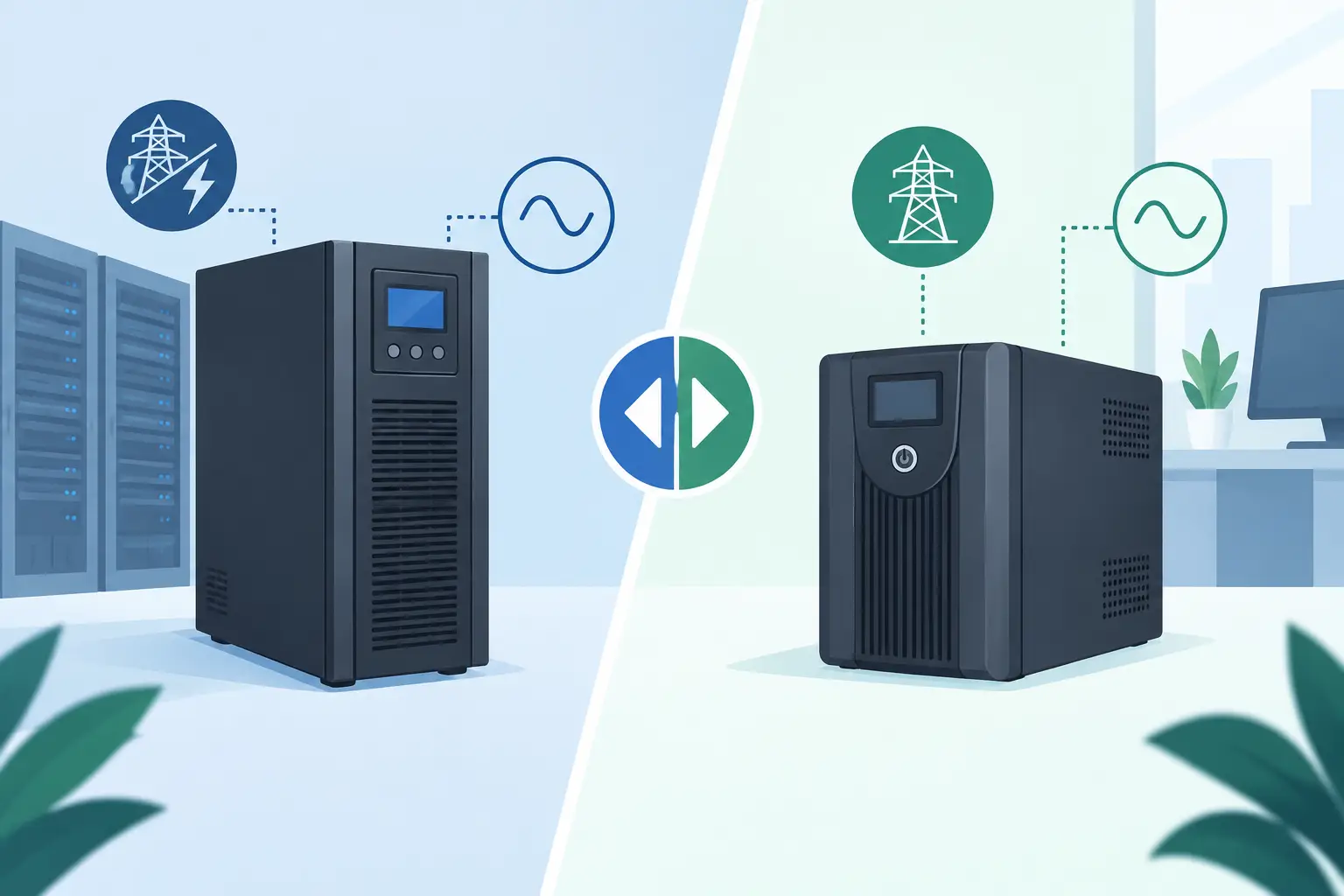
Online UPS versus line interactive: the core difference
A line-interactive UPS normally supplies mains power directly to connected equipment while monitoring the incoming supply. Its automatic voltage regulation (AVR) corrects moderate low and high voltage conditions without using the battery. When mains power fails or moves outside its accepted range, the UPS switches to battery power through an inverter. This transfer is very fast, often measured in milliseconds, but it is not zero.
An online UPS, also called a double-conversion UPS, continuously converts incoming AC power to DC and then recreates a clean AC output for the load. The connected equipment is supplied by the inverter at all times, rather than directly by the incoming mains. If the utility supply is lost, the battery is already supporting the DC bus, so there is no transfer time for the protected load.
That distinction matters most where even a short disturbance could have operational consequences. An online UPS also offers stronger isolation from frequency variation, harmonics and electrical noise, while delivering a controlled output voltage. For sensitive server, storage and networking environments, this can be a meaningful layer of protection rather than an unnecessary specification.
When a line-interactive UPS is suitable
Line-interactive UPS systems are a practical, cost-effective choice for many business applications. They suit individual workstations, point-of-sale terminals, small network cabinets, desktop PCs, displays and modest office systems where a brief transfer to battery is unlikely to cause disruption.
For a small business using cloud applications and a single broadband router, a correctly sized line-interactive unit can keep connectivity active long enough to save work, complete a transaction or shut systems down safely. Its AVR capability is particularly useful where supply voltage occasionally fluctuates but major power quality problems are not expected.
The trade-off is that the output quality depends more heavily on the incoming supply while the UPS is operating in normal mode. A line-interactive model may not be the right choice for a server room carrying core applications, virtual machines, on-premises storage or systems that support round-the-clock operations. It also requires careful review if the connected equipment has a sensitive power supply or if generators are part of the site power strategy.
For office deployments, battery runtime is often more valuable than premium power conditioning. A line-interactive UPS with enough capacity to support a router, switch and essential workstation for 10 to 20 minutes may be the sensible investment. It gives people time to save work and allows IT teams to manage an orderly shutdown without paying for data-centre-grade features that the load does not require.
When an online UPS is warranted
Online UPS systems are designed for critical loads where uptime and clean power take priority. Typical applications include Dell PowerEdge servers, storage arrays, virtualisation hosts, firewall appliances, core switches, surveillance recording systems, telecommunications equipment and medical or industrial control systems.
They are especially appropriate where a power event could result in corrupted data, prolonged recovery work or loss of customer-facing services. A server can sometimes ride through a short UPS transfer without incident, but designing a business-critical environment around “sometimes” is not a sound continuity plan. Double-conversion technology removes the transfer-time question and provides consistent conditioned power.
Online UPS units also work well in environments with frequent voltage instability, generator use or high-value IT infrastructure. Their ability to accept a wider range of input conditions can reduce unnecessary battery use while maintaining regulated output. However, this protection comes with higher upfront cost, greater heat output and, depending on capacity, more demanding installation requirements.
Efficiency should still be evaluated. Modern online UPS models can offer efficient operating modes, but the selection should account for the site’s load profile, runtime requirement and cooling capacity. An oversized online UPS running at a very low load may not provide the best value. The aim is a properly engineered solution, not simply the largest unit available.
Compare the risk, not only the VA rating
UPS capacity is usually stated in VA and watts. Both figures matter. VA describes apparent power, while watts represent the real power consumed by the connected equipment. A UPS must have sufficient watt capacity for the actual load, not only an impressive-looking VA rating.
Start with an inventory of every device that must remain on during an outage. Include servers, storage, switches, routers, firewalls, wireless controllers, monitors where needed, and any power-over-Ethernet load such as access points or IP phones. Do not overlook startup demand, redundant power supplies and expected future growth.
Runtime is a separate decision from capacity. A UPS may support a load safely but only for a few minutes. That can be enough if the purpose is automated shutdown or generator bridging. If operations must continue through a longer outage, external battery packs, a higher-capacity UPS or generator integration may be required.
For a server room, it is often wise to plan for staged protection. Core infrastructure receives online UPS coverage with controlled shutdown software, while non-essential equipment is excluded. This preserves battery runtime for the systems that protect business operations. It also avoids a common mistake: connecting every available device to the UPS until its runtime becomes too short to be useful.
Power protection should support the wider IT design
A UPS cannot compensate for poor infrastructure design. Redundant server power supplies should be connected to separate protected circuits where possible. Network equipment should be labelled clearly, and shutdown sequences should be tested rather than assumed. Batteries need inspection and replacement on schedule, because a UPS with depleted batteries may appear healthy until the first real outage.
Monitoring is equally valuable. Network-managed UPS systems can alert IT teams to battery condition, load level, input events and remaining runtime. For organisations with distributed sites or unattended network cabinets, these alerts make it possible to address issues before a power incident becomes downtime.
The right answer may also differ within the same organisation. A line-interactive UPS can be appropriate for executive workstations and branch-office networking, while an online Eaton UPS protects the main server room and storage environment. This targeted approach controls cost without compromising critical services.
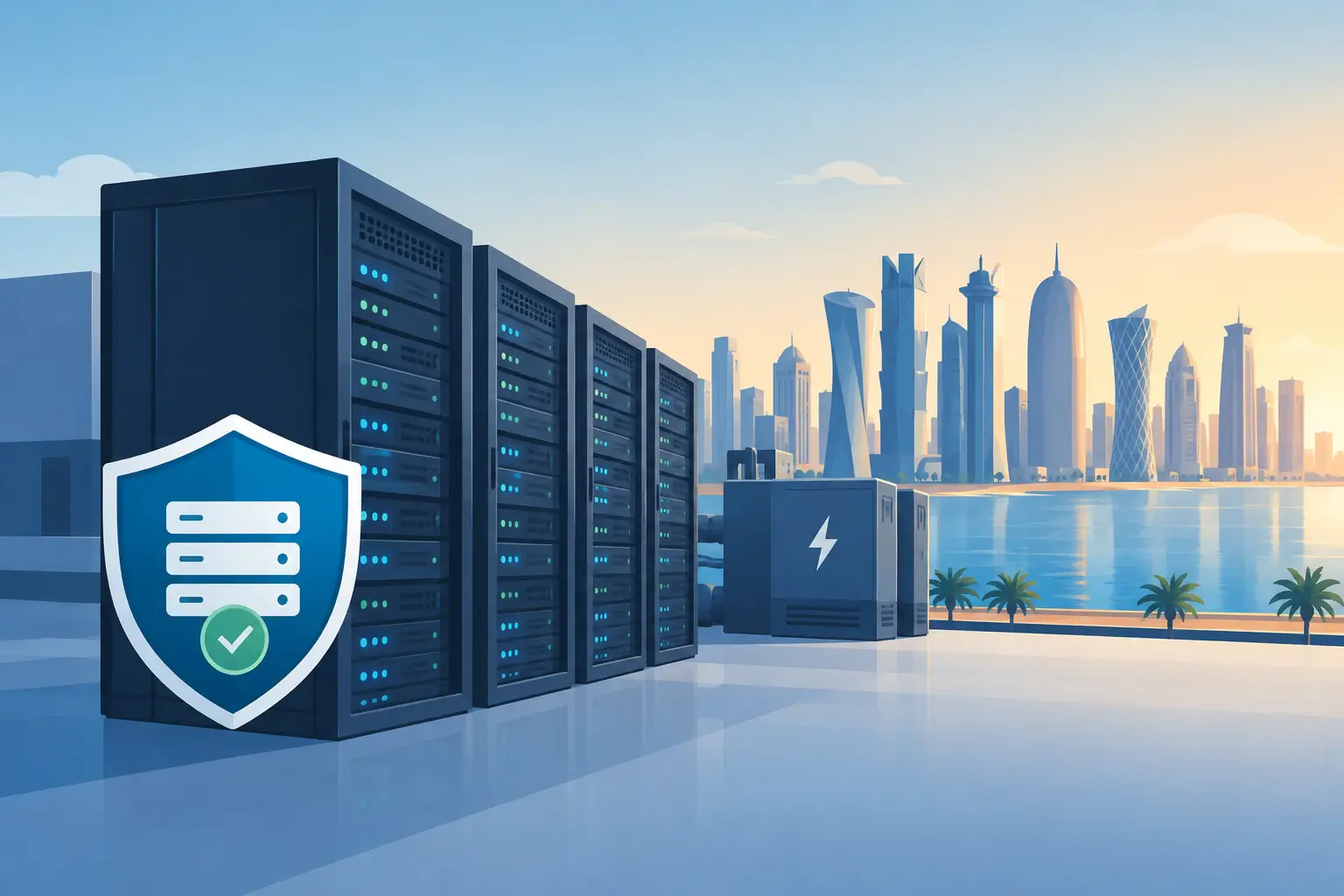
Choosing a UPS partner in Qatar
Local assessment matters because UPS selection involves more than choosing a model from a specification sheet. Site electrical conditions, rack space, heat, runtime targets, generator configuration and future expansion all affect the result. Installation quality, battery support and response time after deployment are just as relevant as the unit itself.
Delta Business Systems W.L.L. helps organisations across Qatar specify Eaton UPS solutions for offices, server rooms and data-centre environments. We can assess the protected load, recommend an appropriate online or line-interactive architecture, and support installation, configuration and ongoing maintenance. Genuine products with official manufacturer warranty, local stock availability in Doha, fast delivery across Qatar and competitive corporate or bulk pricing are available on request.
A well-chosen UPS should give your team time to act, keep critical systems stable and reduce the chance that a minor electrical event becomes a business interruption. To request a quotation or product consultation, email business@dbsqatar.com or call +974 3139 3916. The most effective power-protection plan is the one matched to the systems your organisation cannot afford to lose.